Guest Article by Rüdiger Christ
South West Thuringia approves major wind energy expansion despite protests
On Wednesday, a public meeting of the South West Thuringia Regional Planning Association (RPG) was held in Suhl. The agenda included a vote to approve the second draft of the South West Thuringia Regional Plan, which designates priority zones for wind energy—areas where wind turbines may be constructed in the future.
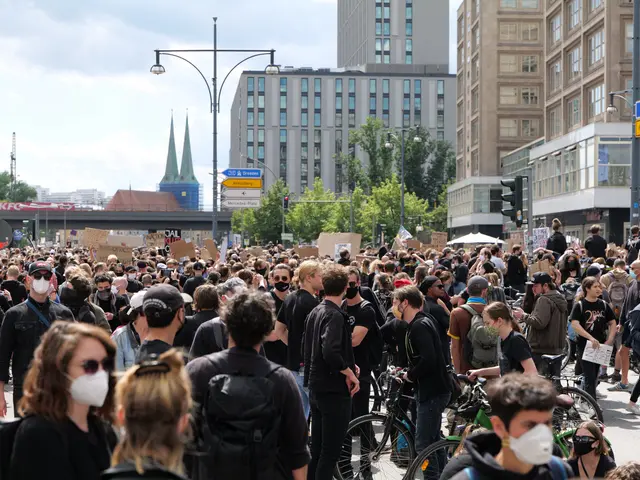
Local wind power critics had called for a "silent protest," drawing numerous participants from the Rhön region. Among them were members of the Stadtlengsfeld Citizens' Initiative Against Wind Turbines in Forests (BI), who traveled to the city in the "Green Heart" of Germany with signs and banners.
A BI activist commented: "We had some concerns about a midweek protest scheduled for 9:30 AM—would enough people show up? On top of that, most participants faced at least an hour's drive to get there.
How wrong we were! Chuck Norris may be dead, but resistance to wind turbines in the Thuringian Forest is very much alive! Around 150 people turned out, and the sea of signs was impressive.
The message was clear: No political party can ignore the issue of wind power in forests, and they will be judged by their stance. The Stadtlengsfeld Citizens' Initiative made its presence felt, with many members on site. Their banner, featuring an aerial view of the forest between Hembacher Höhe and Langenfelder Abspann, was powerful and the real eye-catcher," said the activist.
Dr. Johannes Görg, a spokesperson for the BI, was also pleasantly surprised by the turnout: "The fact that around 150 highly committed individuals from roughly ten anti-wind-power citizens' groups took part sends a strong signal—our movement is growing rapidly."
However, Görg and his fellow activists were disappointed with the meeting's outcome. While Wartburgkreis District Administrator Michael Brodführer (CDU), who chairs the RPG, welcomed the demonstrators, the subsequent vote showed clear support for the draft, with 21 members in favor.
Sonneberg District Administrator Robert Sesselmann (AfD) and Schalkau Mayor Mark Schwimmer (independent) voted against it.
The approved draft designates 40 wind priority zones in South West Thuringia, seven of which are in the Rhön. Over the coming years, new turbines could be built in the following areas:
- Dietrichsberg near Vacha
- Hetzeberg near Möhra
- Hoppberg near Dorndorf
- Lohberg near Vacha
- Salzunger Berg near Weilar
- Ripperts near Wernshausen
- Hetzberg near Christes/Grumbach
- Tellerberg near Viernau
- Wacholderberg near Mehmels
- Hessenkoppe near Meiningen
- Knotenberg near Dillstädt
- Schneeberg near Grub
- Ahlstädter Berg near Schleusingen
- Mittelberg near Vachdorf
- Hoher Schuss near Ernstthal
- Wölfershausener Wald near Bauerbach
- Beinerstadt
- Häseliether Forst near Hildburghausen (North)
- Schlotberg near Jüchsen
- Breitberg near Dingsleben
- Thomasberg near Eisfeld (West)
- Behrunger Höhe (Grabfeld)
- Klettnitzberg near Neuenbau
- Weites Feld near Eisfeld (East)
- Lossbrand near Hämmern/Blechhammer
- Hohe Wart near Hildburghausen (South)
- Warth near Römhild
- Klauenkopf near Straufhain
- Harte Leite near Gompertshausen
- Ummerstädter Wald
- Höhberg near Hellingen
The former Wind Priority Zone 4, "Bornkopf," has been renamed Wind Priority Zone 14, "Salzunger Berg near Weilar."
Many citizens' initiatives view the significant expansion of these zones with particular concern. The designated area has increased from 0.15% to 1.7%—a fifteenfold rise, now covering roughly 6,900 hectares.
The citizens' initiatives will now focus on the public consultation period, which begins on May 18 and runs for eight weeks, partially overlapping with the summer holidays.